Изучите сотовые сэндвич-структуры, начиная от проектирования сердцевины и выбора материалов до склеивания, производственных проблем и применения в легкой аэрокосмической отрасли.
Honeycomb Sandwich Structures: The Key to Lightweight Engineering
From natural beehives to the primary load-bearing frameworks of spacecraft
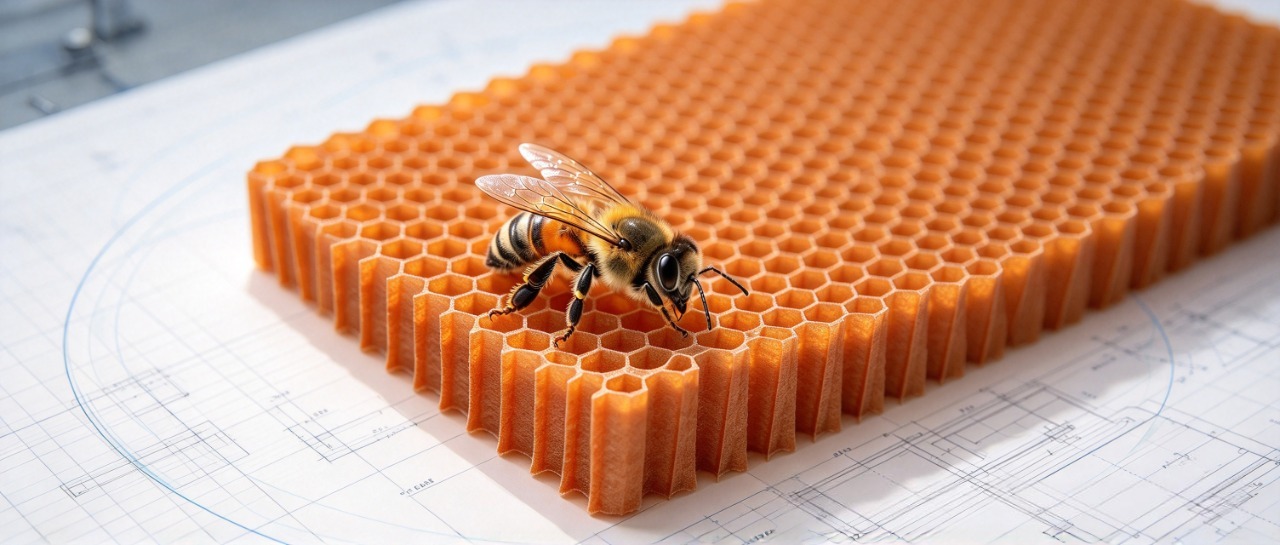
there is a well-known principle in structural design: doubling the thickness of a solid plate increases its flexural rigidity eightfold—but it also doubles its weight. Since solid structures are so inefficient, why not hollow out the middle? Nature provided the answer long ago: bees construct vast, high-strength honeycombs using a minimal amount of wax. In engineering, the "sandwich" design—which replicates this structure—serves as the fundamental secret behind modern lightweight construction.
In the mechanics of materials, strength and stiffness are two distinct concepts. Often, a component fails not because it snaps, but because excessive deformation leads to interference or structural instability. When flexural rigidity becomes the primary bottleneck, the smartest approach isn't to switch to more expensive materials, but rather to redistribute the material—moving it away from the neutral axis and toward the outer surfaces.
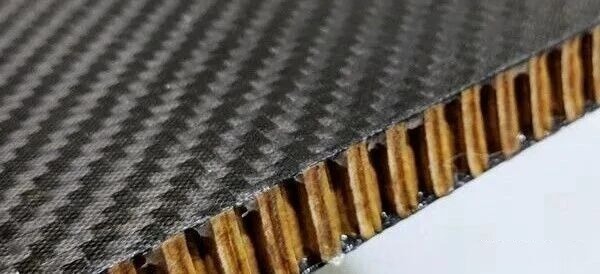
A hollow tube is one application of this logic for circular cross-sections; for plate-like structures, the solution is the sandwich design: thin, rigid "skins" are bonded to the top and bottom, separated by an ultra-lightweight core. While a large portion of a sandwich structure’s volume consists of empty space, the core material effectively binds the two thin skins together, transforming them into a single, integrated I-beam-like structure. The honeycomb core represents the pinnacle of this spatial efficiency in engineering.
I. How is a honeycomb designed? It’s more than just drawing hexagons
When people think of a honeycomb, they often picture a perfect regular hexagon. In reality, this shape is the result of a compromise between mechanical performance, weight, and manufacturing feasibility. In practical design, the behavior of a honeycomb is governed by three interdependent parameters:
wall thickness, cell edge length, and cell height.
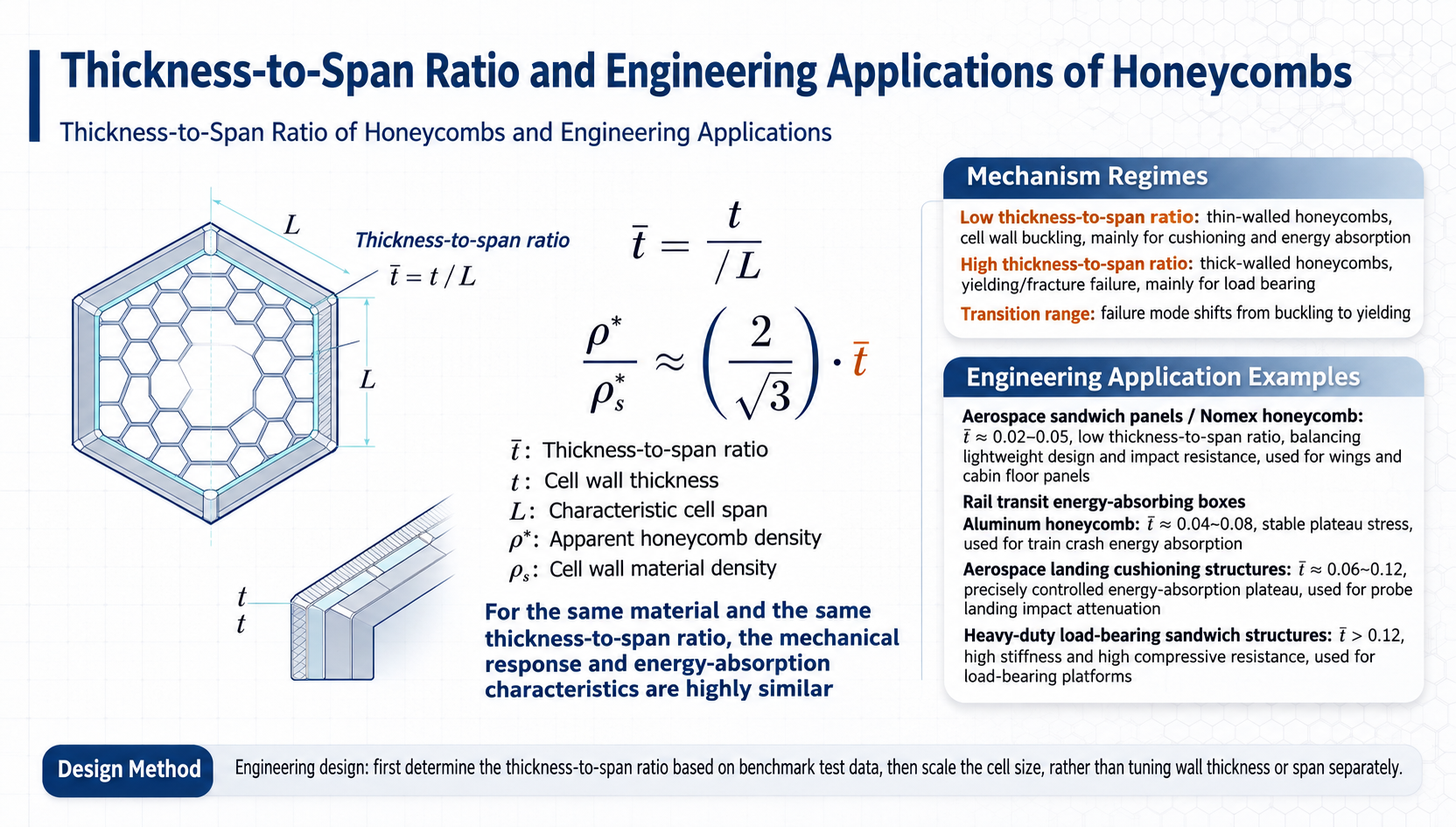
To make a honeycomb more resistant to compression and buckling, the most direct method is to increase the thickness of the cell walls. However, this immediately raises the structure's equivalent density, significantly undermining the goal of lightweight design. If you aim for a lightweight design without increasing total weight, you must elongate the cell walls—in other words, enlarge the cell size. Consequently, experienced engineers do not fixate on a single parameter; instead, they focus on the "thickness-to-span ratio" (the ratio of the cell wall thickness to the cell span). For a given material, as long as this ratio remains constant, the mechanical properties and energy-absorption performance will be highly consistent.
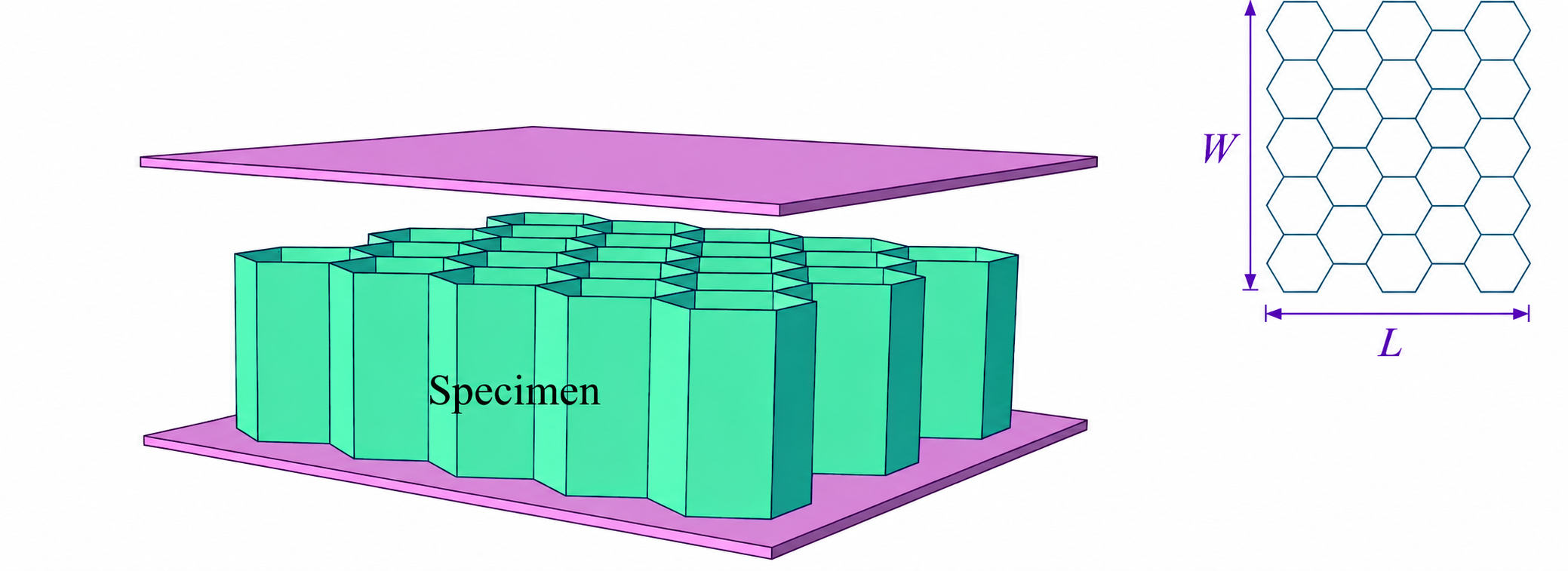
Another common pitfall is anisotropy. Honeycomb structures often exhibit significant differences in shear strength between their two in-plane directions (the L-direction and W-direction)—a characteristic inherent to their hexagonal geometry. If, during the ply-stacking design phase, you fail to align the primary shear-loading direction with the honeycomb’s "strong axis," the structure is highly likely to fail in service due to premature shear-induced buckling (wrinkling) of the core.
Design Tip: Start by defining the spacing between the top and bottom skins and the acceptable core density. Then, use buckling and shear envelope curves to back-calculate the appropriate honeycomb dimensions. Because honeycomb structures are highly directional, ensure that the primary load-bearing axis is oriented correctly.
II. Material Selection Logic: There Is No "Strongest" Material—Only the Most Suitable One
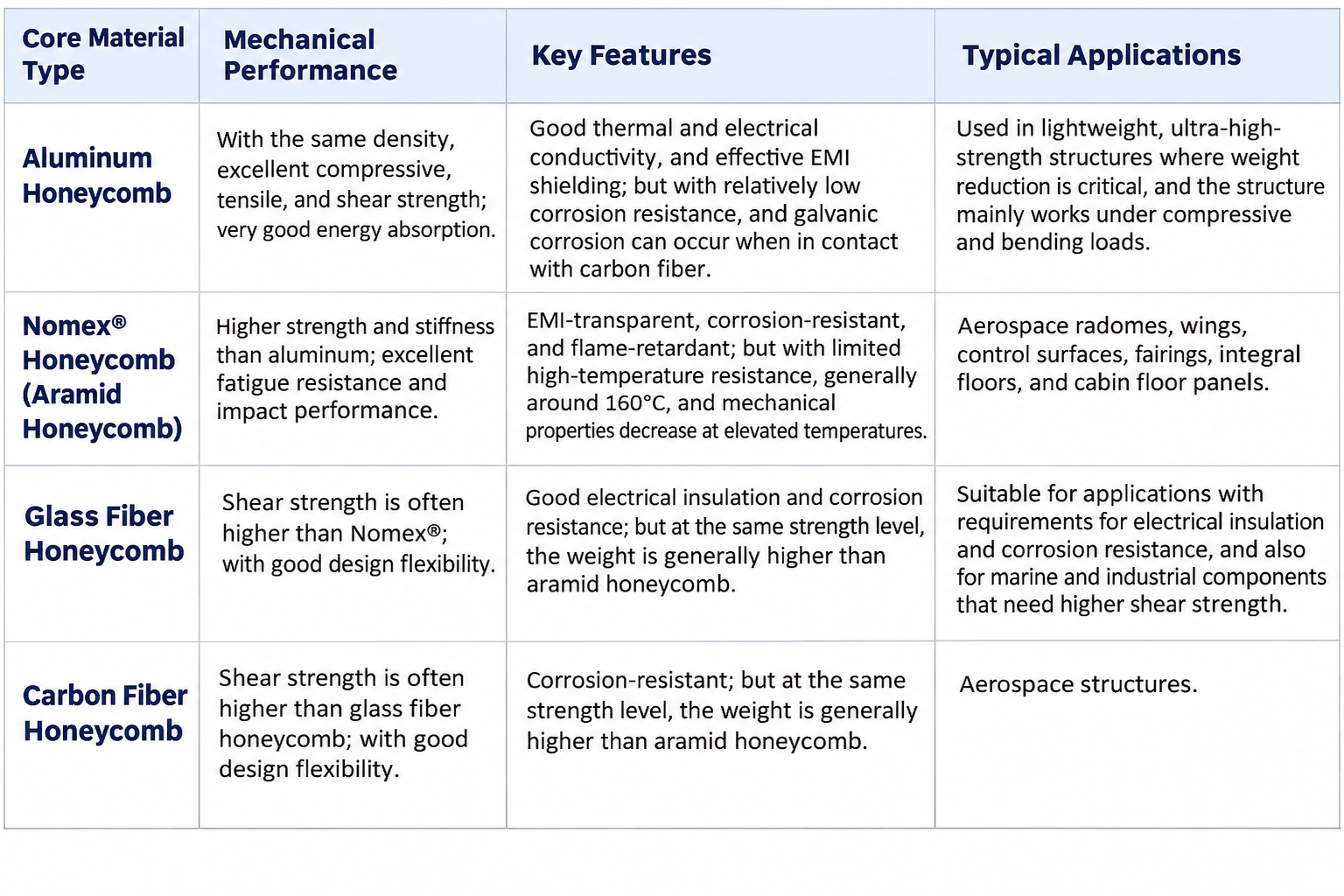
The range of available honeycomb materials is relatively narrow, consisting primarily of aluminum, aramid paper
(Nomex), glass fabric, and
carbon fiber. Despite this limited selection, choosing the wrong material can force a complete overhaul of your manufacturing process and budget.
While the high strength of aluminum honeycomb is attractive, it suffers from a critical flaw: galvanic corrosion. When paired with carbon fiber skins, the presence of moisture triggers electrochemical corrosion—essentially turning the assembly into a battery. If aluminum must be used, a robust isolation layer—such as a glass fiber ply or an insulating fabric—must be applied at the interface. If you cannot guarantee the absolute continuity of this isolation layer during production, it is safer to switch to Nomex honeycomb; you may sacrifice some shear strength, but you gain long-term structural integrity and safety.
Additionally, always keep the temperature limits of Nomex in mind. For structures located near heat sources—such as engine nacelles—never rely solely on material handbook data measured at room temperature for verification. Mechanical properties degrade significantly at high temperatures, so the design envelope must incorporate sufficient margins.
III. The Essence of Sandwich Design
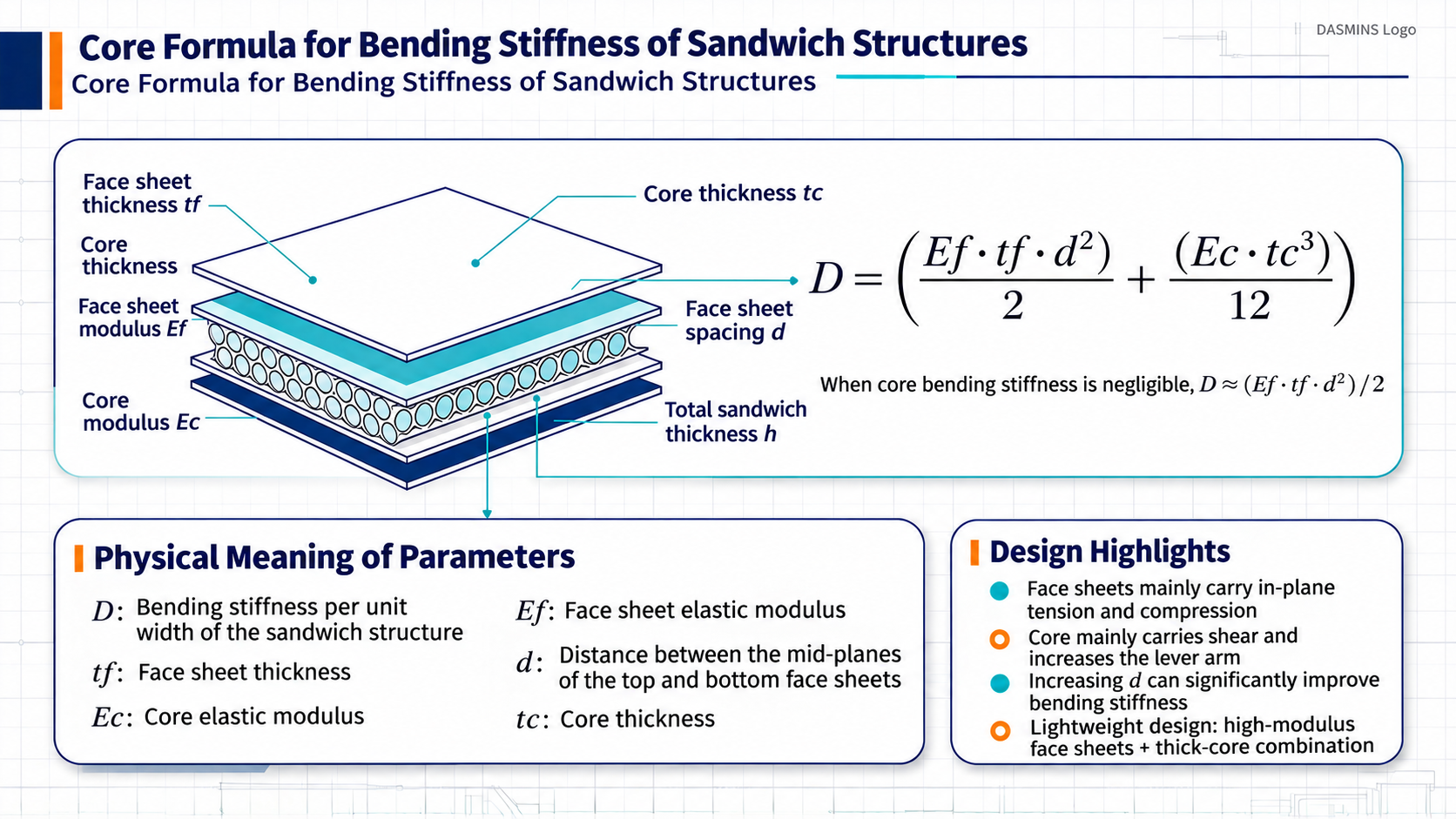
Why is it called a "sandwich" structure? Because the skin and the core serve distinct, well-defined roles: the skins handle tension and bending stresses, while the core acts as a spacer, keeping the upper and lower skins apart and providing out-of-plane support.
Failure modes in sandwich structures are far more complex than those in standard laminates.
The most critical concerns include skin wrinkling, core shear buckling, core cell crushing, interfacial debonding, and global instability.If the core fails in shear, doubling the thickness of the carbon-fiber skins—or upgrading to a superior grade of carbon fiber—is entirely pointless. Conversely, if the skins wrinkle due to inadequate support, switching to a stiffer core will only add unnecessary weight. The most elegant sandwich design is one where, under ultimate design loads, all potential failure modes for both the skin and the core approach their critical limits simultaneously.
Increasing the core thickness does not automatically result in greater rigidity. If the core is too thick, it becomes prone to excessive shear deformation and is highly susceptible to collapse during manufacturing; if it is too thin, the structure fails to achieve the required flexural stiffness.
Examining the core formula for sandwich flexural stiffness reveals the true purpose of the core material: it does not need to be exceptionally strong; its primary function is to enable the honeycomb structure to perform its mechanical role. As long as it can effectively transmit shear forces, maintain the separation between the skins, and provide adequate local support for the skins, it serves as an ideal core material.
Look at the aircraft flying today: control surfaces, fairings, empennage components, interior fittings, and cabin flooring frequently utilize honeycomb sandwich structures. The rudder of the Airbus A340 and the engine nacelles of the Boeing 787, for instance, rely on this design to strike an optimal balance between weight reduction and noise mitigation. Launch vehicles and satellite fairings—such as those used by NASA and SpaceX—rely on this design as a standard feature; the fairing for Elon Musk’s Starship even incorporates a titanium-alloy honeycomb sandwich structure. The same logic applies across land and sea: from the hulls of racing shells and the decking of luxury yachts to the flooring in high-speed trains and new-energy vehicles. The fundamental principle remains the same:
ensure that stiffness-related constraints are reached before structural failure occurs. By strategically placing materials exactly where they are needed most, engineers can squeeze every ounce of excess weight out of a design.
IV. Manufacturing: Where Elegant Design Meets the Reality of Production
No matter how high the calculated stiffness may be on paper, it counts for nothing if the structure collapses, shifts, or delaminates inside the curing oven. In the realm of composite materials, the fabrication of honeycomb sandwich structures is notoriously temperamental.
1. Core Collapse and Slippage: A Double-Edged Sword of Pressure
Honeycomb cores are remarkably delicate under curing pressure. While the air trapped within the cells provides some internal support, taller cores with larger cell sizes are increasingly susceptible to lateral crushing. For instance, a 70mm-tall aramid-paper honeycomb core cannot be properly compacted under a vacuum pressure of 0.03 MPa; yet, without sufficient constraint, the core may spring back or warp once the vacuum bag is removed, preventing the outer skins from bonding correctly. Conversely, one must be careful not to overdo it—0.3 MPa is generally considered the safe upper limit for standard honeycomb sandwich processing.
Areas with steep inclines or chamfered edges are particularly prone to slippage; the vacuum pressure differential can easily cause the core to slide along the slope. Experienced technicians often employ auxiliary rubber molds or edge restraints in these zones to counteract the pressure differential. For exceptionally thick honeycomb cores, a pre-cured fabric layer is sometimes applied to the underside for reinforcement—while this adds weight, it effectively controls deformation and ensures the structural integrity of the core.
2. Splicing and Bonding: Safeguarding the Interface is the Bottom Line
Large-scale panels cannot be constructed from a single, continuous piece of honeycomb; splicing is inevitable. However, every splice introduces a point of mechanical discontinuity. If the adhesive film is too thick, not sufficiently compacted, or if the splice orientation is not aligned with the primary load-bearing direction, this area will be the first to crack during service. Splice joints must, whenever possible, be positioned in zones subject to low shear stress.
Finally, there is the matter of interfacial bonding. Whether it involves the phosphoric acid anodizing of aluminum honeycomb or the careful selection of an adhesive film, the objective is singular: to ensure the top and bottom skins remain firmly bonded to the core material. Should the interface delaminate, the core material instantly becomes useless, and the entire panel effectively degrades into two independent, disconnected thin skins.
A fundamental rule of manufacturing: the stabilization of the core material, the quality control of splice joints, and the integrity of the interfacial bond are critical—fail in any one of these, and the stiffness advantage of the sandwich structure vanishes. The design phase must incorporate a margin for manufacturing tolerances; one should not wait until the curing process yields defective parts before attempting a remedy.
Conclusion: The Secret to Lightweighting Lies in Space
Inspired by the honeycombs found in nature, the sandwich structure serves as the engineering key to achieving lightweight designs. It does not rely on a breakthrough in a specific new material, but rather on a sophisticated three-step approach: positioning material as far as possible from the neutral axis, utilizing a lightweight core to create space, and employing a reliable manufacturing process to solidify the structure. In essence, it uses a core to support thin skins, granting the assembly the structural capability to rival a solid, thick beam.